
History of Cambodia
The history of Cambodia, a country in mainland Southeast Asia, can be traced back to at least the 5th millennium BC.[1] Detailed records of a political structure on territory, what is now modern day Cambodia first appear in Chinese annals in reference to Funan, a polity that encompassed the southernmost part of the Indochinese peninsula during the 1st to 6th centuries. Centered at the lower Mekong,[2] Funan is noted as the oldest regional Hindu culture, which suggests prolonged socio-economic interaction with maritime trading partners of the Indosphere in the west.[3] By the 6th century a civilisation, titled Chenla or Zhenla in Chinese annals, has firmly replaced Funan, as it controlled larger, more undulating areas of Indochina and maintained more than a singular center of power.[4][5]
The Khmer Empire was established by the early 9th century. Sources refer here to a mythical initiation and consecration ceremony to claim political legitimacy by founder Jayavarman II at Mount Kulen (Mount Mahendra) in 802 C.E.[6] A succession of powerful sovereigns, continuing the Hindu devaraja cult tradition, reigned over the classical era of Khmer civilization until the 11th century. A new dynasty of provincial origin introduced Buddhism as royal religious discontinuities and decentralization result.[7] The royal chronology ends in the 14th century. Great achievements in administration, agriculture, architecture, hydrology, logistics, Urban planning and the arts are testimony to a creative and progressive civilization - in its complexity a cornerstone of Southeast Asian cultural legacy.[8]
A transitional period of around 100 years followed, that initiated the Dark Ages or the Middle Period of Cambodian history in the mid 15th century . Although Hindu cult had by then been all but replaced, the monument sites at the old capital remained an important spiritual center.[9] Yet since the mid 15th century the core population steadily moved to the east and - with brief exceptions - settled at the confluence of the Mekong and Tonle Sap rivers at Chaktomuk, Longvek and Oudong.[10][11]
Maritime trade was the basis for a very prosperous 16th century. But, as a result foreigners - Muslim Malays and Cham, ChristianEuropean adventurers and missionaries - increasingly disturb and influence government affairs. Ambiguous fortunes, a robust economy on the one hand and a disturbed culture and compromised royalty on the other are continuing features of the Longvek era.[12][13]
By the 15th century, the Khmers' traditional neighbors, the Mon people in the west and the Cham people in the east had gradually been pushed aside or replaced by the resilient Siamese/Thai and Annamese/Vietnamese.[14] These powers had perceived, understood and increasingly followed the imperative of controlling the lower Mekong basin as the key to control all Indochina. A weak Khmer kingdom only encouraged the strategists in Ayutthaya (later Bangkok) and Huế. Attacks on and conquests of Khmer royal residences left sovereigns without a ceremonial and legit power base.[15][16] Interference in succession and marriage policies added to the decay of royal prestige. Oudong was established in 1601 as the last royal residence of the Middle Period.[17]
The 19th century arrival of technologically superior and ambitious European colonial powers with policies of concrete global control put an end to regional feuds and asSiam/Thailand, although humiliated and on the retreat, escaped colonization as a buffer state, Vietnam was to be the focal point of French colonial ambition.[18] [19] Cambodia, although largely neglected, had entered the Indochinese Union as a perceived entity and was capable to carry and reclaim its identity and integrity into modernity.[20][21]
After 80 years of colonial hibernation, the brief episode of Japanese occupation during World War 2, that coincided with the investiture of king Sihanouk was to become the opening act[22] for the irreversible process towards re-emancipation and modern Cambodian history. The Kingdom of Cambodia (1953–70), independent since 1953, struggled to remain neutral in a world shaped by polarisation of the nuclear powers USA and Soviet Union.[23] As the Indochinese war escalates, Cambodia becomes its most prominent casualty,[24] the Khmer Republic is one of the results in 1970, another is civil war. 1975, abandoned and in the hands of the Khmer Rouge, Cambodia endures its darkest hour -Democratic Kampuchea[25] and its long aftermath of Vietnamese occupation, the People's Republic of Kampuchea and the UN Mandate towards Modern Cambodia since 1993.
Prehistory and early history

Carbon 14 dating of a cave at Laang Spean in Battambang Province, northwest Cambodia confirmed the presence of Hoabinhian stone tools from 6000-7000 BC and pottery from 4200 BC.[26][27] Starting in 2009 archaeological research of the Franco-Cambodian Prehistoric Mission has documented a complete cultural sequence from more than 100,000 years to the Neolithic period in the cave.[28] Finds since 2012 lead to the common interpretation, that the cave contains the archaeological remains of a first occupation by hunter and gatherer groups, followed by Neolithic people with highly developed hunting strategies and stone tool making techniques, as well as highly artistic pottery making and design, and with elaborate social, cultural, symbolic and funerary practices.[29]
Skulls and human bones found at Samrong Sen in Kampong Chhnang Province date from 1500 BC. Heng Sophady (2007) has drawn comparisons between Samrong Sen and the circular earthwork sites of eastern Cambodia. These people may have migrated from South-eastern China to the Indochinese Peninsula. Scholars trace the first cultivation of rice and the first bronze making in Southeast Asia to these people.[30]
2010 Examination of skeletal material from graves at Phum Snay in north-west Cambodia revealed an exceptionally high number of injuries, especially to the head, likely to have been caused by interpersonal violence. The graves also contain a quantity of swords and other offensive weapons used in conflict.[31]
The Iron Age period of Southeast Asia begins around 500 BC and lasts until the end of the Funan era - around 500 A.D. as it provides the first concrete evidence for sustained maritime trade and socio-political interaction with India and South Asia. By the 1st century settlers have developed complex, organized societies and a varied religious cosmology, that required advanced spoken languages very much related to those of the present day. The most advanced groups lived along the coast and in the lower Mekong River valley and the delta regions in houses on stilts where they cultivated rice, fished and kept domesticated animals.
Funan Kingdom (1st century AD – 550)

Chinese annals[35] contain detailed records of the first known organized polity, the thalassocratic[36] Kingdom of Funan, on Cambodian and Vietnamese territory characterized by "high population and urban centers, the production of surplus food...socio-political stratification [and] legitimized by Indian religious ideologies".[37][38] Centered around the lower Mekong and Bassac rivers from the first to sixth century C.E. with "walled and moated cities"[39] such as Angkor Borei in Takeo Province and Óc Eo in modern An Giang Province, Vietnam.
Early Funan was composed of loose communities, each with its own ruler, linked by a common culture and a shared economy of rice farming people in the hinterland and traders in the coastal towns, who were economically interdependent, as surplus rice production found its way to the ports.[40]
By the second century C.E. Funan controlled the strategic coastline of Indochina and the maritime trade routes. Cultural and religious ideas reached Funan via the Indian Ocean trade route. Trade with India had commenced well before 500 BC as Sanskrit hadn't yet replaced Pali.[41] Indian author Dr. Pragya Mishra observes: "Funan Was One Of The Colonies Established By Indians Within Cambodia...[sic]" in his essay "Cultural History of Indian Diaspora in Cambodia".[42] Funans language has been determined as to have been an early form of Khmer and its written form was Sanskrit.

In the period 245-250 C.E. dignitaries of the Chinese Kingdom of Wu visited the Funan city Vyadharapura.[44] Envoys Kang Tai and Zhu Ying defined Funan as to be a distinct Hindu culture.[45] Trade with China had begun after the southward expansion of the Han Dynasty, around the 2nd century B.C. Effectively Funan "controlled strategic land routes in addition to coastal areas"[46] and occupied a prominent position as an "economic and administrative hub"[47][48] between The Indian ocean trade network and China, collectively known as the Maritime Silk Road. Trade routes, that eventually ended in distant Rome are corroborated by Roman and Persian coins and artifacts, unearthed at archaeological sites of 2nd and 3rd century settlements.[49][50]
Funan is associated with myths, such as the Kattigara legend and the Khmer founding legend in which an Indian Brahman or prince named Preah Thaong in Khmer, Kaundinya in Sanskrit and Hun-t’ien in Chinese records marries the local ruler, a princess named Nagi Soma (Lieu-Ye in Chinese records), thus establishing the first Cambodian royal dynasty.[51]
Scholars debate as to how deep the narrative is rooted in actual events and on Kaundinya's origin and status.[52][53] A Chinese document, that underwent 4 alterations[54] and a 3rd century epigraphic inscription of Champa are the contemporary sources.[55] Some scholars consider the story to be simply an allegory for the diffusion of Indic Hindu and Buddhist beliefs into ancient local cosmology and culture[56]whereas some historians dismiss it chronologically.[57][58]
Chinese annals report that Funan reached its territorial climax in the early 3rd century under the rule of king Fan Shih-man, extending as far south as Malaysia and as far west as Burma. A system of mercantilism in commercial monopolies was established. Exports ranged from forest products to precious metals and commodities such as gold, elephants, ivory, rhinoceros horn, kingfisher feathers, wild spices like cardamom, lacquer, hides and aromatic wood. Under Fan Shih-man Funan maintained a formidable fleet and was administered by an advanced bureaucracy, based on a "tribute-based economy, that produced a surplus which was used to support foreign traders along its coasts and ostensibly to launch expansionist missions to the west and south".[59]
Historians maintain contradicting ideas about Funan's political status and integrity.[60] Miriam T. Stark calls it simply Funan: [The]"notion of Fu Nan as an early "state"...has been built largely by historians using documentary and historical evidence" and Michael Vickery remarks: "Nevertheless, it is...unlikely that the several ports constituted a unified state, much less an 'empire'".[61] Other sources though, imply imperial status: "Vassal kingdoms spread to southern Vietnam in the east and to the Malay peninsula in the west"[62] and "Here we will look at two empires of this period...Funan and Srivijaya".[63]
The question of how Funan came to an end is in the face of almost universal scholarly conflict impossible to pin down. Chenla is the name of Funan's successor in Chinese annals, first appearing in 616/617 C.E.
Dark ages of Cambodia (1431–1863)
The term Dark ages of Cambodia, also the Middle Period[88] refers to the historical era from the early 15th century to 1863, the beginning of the French Protectorate of Cambodia. Reliable sources - particularly for the 15th and 16th century - are very rare. A conclusive explanation that relates to concrete events manifesting the decline of the Khmer Empire has not yet been produced.[89][90] However, most modern historians consent that several distinct and gradual changes of religious, dynastic, administrative and military nature, environmental problems and ecological imbalance[91] coincided with shifts of power in Indochina and must all be taken into account in order to make an interpretation.[92][93][94] In recent years focus has notably shifted towards studies on climate changes, human–environment interactions and the ecological consequences.[95][96][97][98]
Epigraphy in temples, ends in the third decade of the fourteenth, and does not resume until the mid-16th century. Recording of the Royal Chronology discontinues with King Jayavarman IX Parameshwara (or Jayavarma-Paramesvara) - there exists not a single contemporary record of even a king’s name for over 200 years. Construction of monumental temple architecture had come to a standstill after Jayavarman VIIth reign. According to author Michael Vickery there only exist external sources for Cambodia’s 15th century, the Chinese Ming Shilu annals and the earliest Royal Chronicle of Ayutthaya.[99][100] Wang Shi-zhen (王世貞), a Chinese scholar of the 16th century, remarked: "The official historians are unrestrained and are skilful at concealing the truth; but the memorials and statutes they record and the documents they copy cannot be discarded."[101][102]
The central reference point for the entire 15th century is a Siamese intervention of some undisclosed nature at the capital Yasodharapura (Angkor Thom) around the year 1431. Historians relate the event to the shift of Cambodia's political center southward to the region of Phnom Penh, Longvek and later Oudong.
Sources for the 16th century are more numerous. The kingdom is centred at the Mekong, prospering as an integral part of the Asian maritime trade network,[106][107] via which the first contact with European explorers and adventurers does occur.[108] as the first contact with European explorers and adventurers does occur. Wars with the Siamese result in loss of territory and eventually the conquest of the capital Longvek in 1594. The Vietnamese on their "Southward March" reach Prei Nokor/Saigon at the Mekong Delta in the 17th century. This event initiates the slow process of Cambodia losing access to the seas and independent marine trade.[109]
Siamese and Vietnamese dominance intensified during the 17th and 18th century, resulting in frequent displacements of the seat of power as the Khmer royal authority decreased to the state of a vassal.[110] In the early 19th century with dynasties in Vietnam and Siam firmly established, Cambodia was placed under joint suzerainty, having lost its national sovereignty. British agent John Crawfurd states: "...the King of that ancient Kingdom is ready to throw himself under the protection of any European nation..." In order to save Cambodia from being incorporated into Vietnam and Siam, King Ang Duong agreed to colonial France's offers of protection, which took effect with King Norodom Prohmbarirak signing and officially recognizing the French protectorate on August 11, 1863.[111]
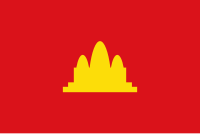
Democratic Kampuchea (Khmer Rouge era) (1975–79)
Immediately after its victory, the CPK ordered the evacuation of all cities and towns, sending the entire urban population into the countryside to work as farmers, as the CPK was trying to reshape society into a model that Pol Pot had conceived.
The new government sought to completely restructure Cambodian society. Remnants of the old society were abolished and religion was suppressed. Agriculture was collectivized, and the surviving part of the industrial base was abandoned or placed under state control. Cambodia had neither a currency nor a banking system.
Democratic Kampuchea's relations with Vietnam and Thailand worsened rapidly as a result of border clashes and ideological differences. While communist, the CPK was fiercely nationalistic, and most of its members who had lived in Vietnam were purged. Democratic Kampuchea established close ties with the People's Republic of China, and the Cambodian-Vietnamese conflict became part of the Sino-Soviet rivalry, with Moscow backing Vietnam. Border clashes worsened when the Democratic Kampuchea military attacked villages in Vietnam. The regime broke off relations with Hanoi in December 1977, protesting Vietnam's alleged attempt to create an Indochina Federation. In mid-1978, Vietnamese forces invaded Cambodia, advancing about 30 miles (48 km) before the arrival of the rainy season.
The reasons for Chinese support of the CPK was to prevent a pan-Indochina movement, and maintain Chinese military superiority in the region. The Soviet Union supported a strong Vietnam to maintain a second front against China in case of hostilities and to prevent further Chinese expansion. Since Stalin's death, relations between Mao-controlled China and the Soviet Union had been lukewarm at best. In February to March 1979, China and Vietnam would fight the brief Sino-Vietnamese War over the issue.
In December 1978, Vietnam announced the formation of the Kampuchean United Front for National Salvation (KUFNS) under Heng Samrin, a former DK division commander. It was composed of Khmer Communists who had remained in Vietnam after 1975 and officials from the eastern sector—like Heng Samrin and Hun Sen—who had fled to Vietnam from Cambodia in 1978. In late December 1978, Vietnamese forces launched a full invasion of Cambodia, capturing Phnom Penh on January 7, 1979 and driving the remnants of Democratic Kampuchea's army westward toward Thailand.
Within the CPK, the Paris-educated leadership—Pol Pot, Ieng Sary, Nuon Chea, and Son Sen—were in control. A new constitution in January 1976 established Democratic Kampuchea as a Communist People's Republic, and a 250-member Assembly of the Representatives of the People of Kampuchea (PRA) was selected in March to choose the collective leadership of a State Presidium, the chairman of which became the head of state.
Prince Sihanouk resigned as head of state on April 4. On April 14, after its first session, the PRA announced that Khieu Samphan would chair the State Presidium for a 5-year term. It also picked a 15-member cabinet headed by Pol Pot as prime minister. Prince Sihanouk was put under virtual house arrest.
Social and cultural implications of the regime[edit]
Thousands starved or died of disease during the evacuation and its aftermath. Many of those forced to evacuate the cities were resettled in newly created villages, which lacked food, agricultural implements, and medical care. Many who lived in cities had lost the skills necessary for survival in an agrarian environment. Thousands starved before the first harvest. Hunger and malnutrition—bordering on starvation—were constant during those years. Most military and civilian leaders of the former regime who failed to disguise their pasts were executed. Some of the ethnicities in Cambodia, such as the Cham suffered specific and targeted and violent persecutions. To the point of some international sources referring to it as the "Cham genocide". Entire families and towns were targeted and attacked with the goal of significantly diminishing their numbers and eventually eliminated them.[1] Life in 'Democratic Kampuchea' was strict and brutal. In many areas of the country people were rounded up and executed for speaking a foreign language, wearing glasses, scavenging for food, and even crying for dead loved ones. Former businessmen and bureaucrats were hunted down and killed along with their entire families; the Khmer Rouge feared that they held beliefs that could lead them to oppose their regime. A few Khmer Rouge loyalists were even killed for failing to find enough 'counter-revolutionaries' to execute.
Modern research has located 20,000 mass graves from the Khmer Rouge era all over Cambodia. Various studies have estimated the death toll at between 740,000 and 3,000,000, most commonly between 1.4 million and 2.2 million, with perhaps half of those deaths being due to executions, and the rest from starvation and disease.[137]
The U.S. State Department-funded Yale Cambodian Genocide Project estimates approximately 1.7 million.[138] R. J. Rummel, an analyst of historical political killings, gives a figure of 2 million.[139]
A UN investigation reported 2–3 million dead, while UNICEF estimated 3 million had been killed.[140] Demographic analysis by Patrick Heuveline suggests that between 1.17 and 3.42 million Cambodians were killed,[141] while Marek Sliwinski estimates that 1.8 million is a conservative figure.[142] Researcher Craig Etcheson of the Documentation Center of Cambodia suggests that the death toll was between 2 and 2.5 million, with a "most likely" figure of 2.2 million. After 5 years of researching grave sites, he concluded that "these mass graves contain the remains of 1,386,734 victims of execution".


No comments:
Post a Comment